
This is it.
In Prose.

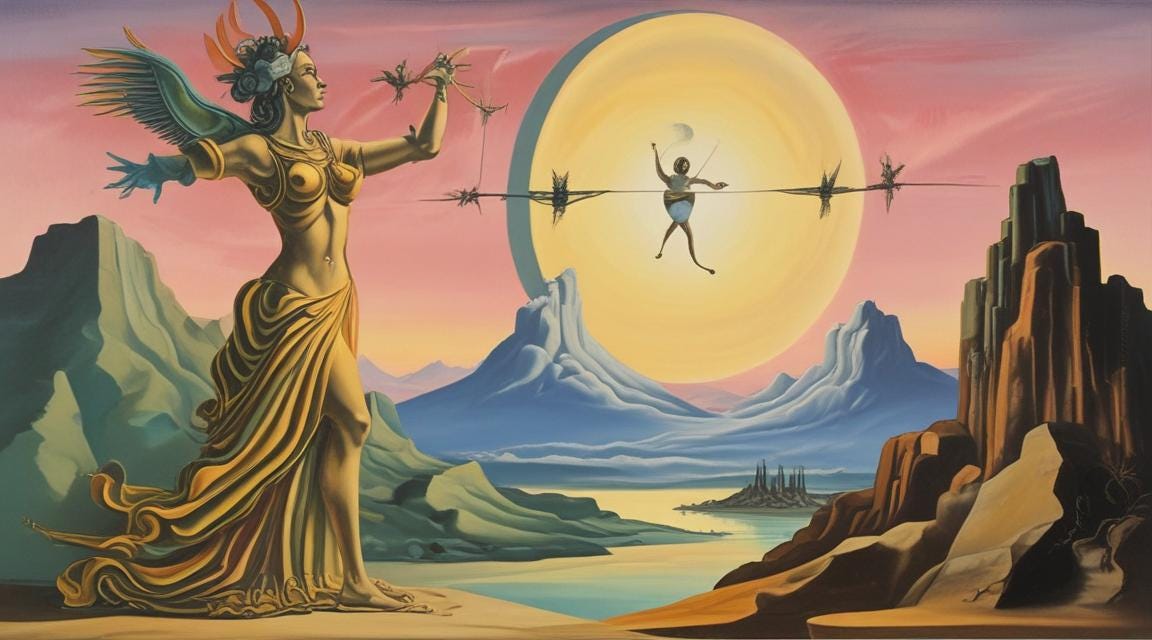
Life is just a series of awakenings followed by brief moments of slumber, when you truly think about it— You open your eyes to another dawn, and notice that all is bright fluorescent in high definition. It feels true and it feels bold, so you latch on to the new light with wide-eyed alacrity.
The idea that a greater destitute now pushes you toward acumen and fulfillment; and then you do all of this for as long as you can; until the light goes away; then you’re forced to close your eyes; and fall into a deep state of DMT consciousness somewhere within your own brain matter— salutations; until next time.
But there isn’t always a next time, and there isn’t always going to be a second try. Our fate is to live and die; those are the only two certainties of existence. But what if you were to try and change your fate? How might that change your destiny? And more so, what might that kind of change take the form of? A life of insomnia? Never falling asleep means you’re always in the front of the line for the next dawning bright.
But then, even in the pursuit of perpetual wakefulness, what are you actually awake to? What does it mean to be constantly alert, perpetually aware, yet never able to fully partake in the slumber that your body craves? It’s as though you’d be stuck in a world without respite, without the luxury of surrendering to the rhythm of the universe. It’s not just the sleep you’d be forsaking, it’s the silence, the stillness, the retreat into oblivion that offers a brief but necessary respite to the soul.
Or is it eternal darkness? Is it existing within existential comatose— your eyes closed tight with anticipation as the meds begin to take: sedation of one reality in order to fully embrace another. Is it the numbing of consciousness? a shut-off switch? a surrender to the soothing quiet of nothingness? But is it really nothingness? We tell ourselves it is. We tell ourselves that what we can’t see, what we can’t touch, must not matter. But maybe it’s all still there, just lurking beneath the surface.
Maybe the darkness is the most honest state of being. There’s comfort in the absence of expectation. There’s no pressure to be anything, to go anywhere, to do anything. It’s the place where the frantic clamor of ambition fades into the background and the endless clockwork of life winds down to a stillness that can almost feel like peace. But even in the comfort of darkness, there is a nagging question. What happens when the lights flicker back on? What happens when the stillness breaks, when the silence is shattered by the harshness of reality reawakening?
Perhaps to understand eternal life is to understand how it has always been; right up until the here and now; and that nothing ever really dies. We like to think of death as an end, as a closing chapter, the finality of existence. But what if death is just another transition, another doorway to a different kind of experience? What if the fabric of the universe is woven with the threads of endless transformations, and everything—every consciousness, every fleeting moment, every interaction—lives on, persists in some way we can’t comprehend? Maybe death is simply the shedding of one skin for another, a constant evolution of being.
Perhaps the key to immortality isn’t about living forever in the physical sense, but rather existing in the network of eternal consciousness that stretches beyond the confines of space and time, that links all things together in a seamless web of interconnectedness. Maybe the real question isn’t whether or not life continues after death, but rather what happens in the in-between—what happens in the spaces where we exist without answers, without clear paths, wandering through the void of possibility.
And what if we must admit to ourselves that this corporeal existence isn’t anything more than a never ending cycle of curvatures experiencing itself simultaneously and that even history repeats itself and that human existence is nothing more than a network of everlasting consciousnesses continuously spreading across the interdenominational plain.
How many times have we lived the same life, only in different forms, under different circumstances? The human story is a long, repetitive loop—what we think of as linear time is just an illusion, a construct of our minds to make sense of the eternal recurrence of experience.
Or Perhaps history doesn’t just repeat itself, it echoes, it reverberates through every corner of our lives. The same emotions, the same desires, the same conflicts arise again and again in different iterations. We are the sum of our past, our ancestors, our former selves.
Every decision we make, every action we take, is like a stone dropped into the river of time, sending ripples that carry forward into the future. But the question remains: are we trapped in a cycle of repetition, forever condemned to relive the same patterns, or can we break free from this eternal loop and transcend it? And what would it mean to transcend it? Would we even recognize ourselves if we did?
It’s been said that the most regrettable moments in life are, by and large, more like compilations of reoccurring moments which fill in tiny gaps of a much bigger picture. These moments haunt us for decades; often finding ways to make us feel inferior. The most haunting regrets aren’t the ones that we experience in a single, isolated instance—they’re the regrets that accumulate, the ones that rise up from the past like a tidal wave of unresolved emotions. We carry them with us, silently, like ghosts that refuse to leave us alone.
They take root in the corners of our minds, resurfacing at odd moments, when we least expect them. A forgotten word, an unspoken thought, a decision we never made but wish we had. They form the landscape of our past, creating a jagged, unforgiving terrain we have to navigate every day.
But here’s the thing: what if those moments aren’t failures? What if they’re not mistakes at all? What if they are simply steps on a path that has no end, only direction? What if the very fact that we regret them is a sign that we’re still growing, still moving forward?
We regret because we care. We regret because we long for something better, for something more than what we’ve had. Regret is the human condition, a marker of the infinite potential that lies within each of us, constantly pushing against the walls of what we think we know. And so, in a sense, we must come to terms with our regrets, learn to live with them, to make them part of us rather than letting them define us.
There was a timeline I once existed among when I would have felt an eternal victim toward such fate. But then reality transformed itself; and in the new light came perception; a renaissance man— Michelangelo’s squired witness to the birth of the Sistine Chapel; the mural of life abstained from mastery’s resolve ‘till filled with proper imperfection.
There’s a certain beauty in the imperfections of our human condition— a kind of raw, unrefined truth that only exists when we stop trying to make things perfect. Michelangelo’s Sistine Chapel wasn’t a product of flawlessness; it was a labor of passion, of struggle, of messy, unfiltered creativity. It was through the cracks, through the imperfections, that the true nature of the work emerged. Maybe that’s how life is too. We spend so much of our time trying to polish the surface, to make things look neat and tidy, when in reality, it’s the rough edges, the places where we’ve been scarred and bruised, that make us real.
The true masterpiece of life isn’t found in the moments when we get everything right; it’s found in the moments when we get it wrong, when we fall apart, when we are broken open and can finally see the light shining through the cracks. That’s where the beauty lies, in the imperfection, in the unfinished, in the messy, chaotic truth of who we are.
And as we wander through the corridors of our own lives, chasing light and running from darkness, we come to realize that both are necessary. The light shows us the way, but the darkness teaches us how to see. We exist in the space between, perpetually oscillating between moments of clarity and confusion, always reaching, always searching. But perhaps the most important question isn’t whether or not we can find the light, but whether we can learn to live with the darkness, to embrace it as part of the whole. For in the end, it is the darkness that keeps our candles burning.
this really moved me. the line—‘there’s comfort in the absence of expectation’—hit something deep. thank you for putting to words the poignant liminality of life we so often overlook.